

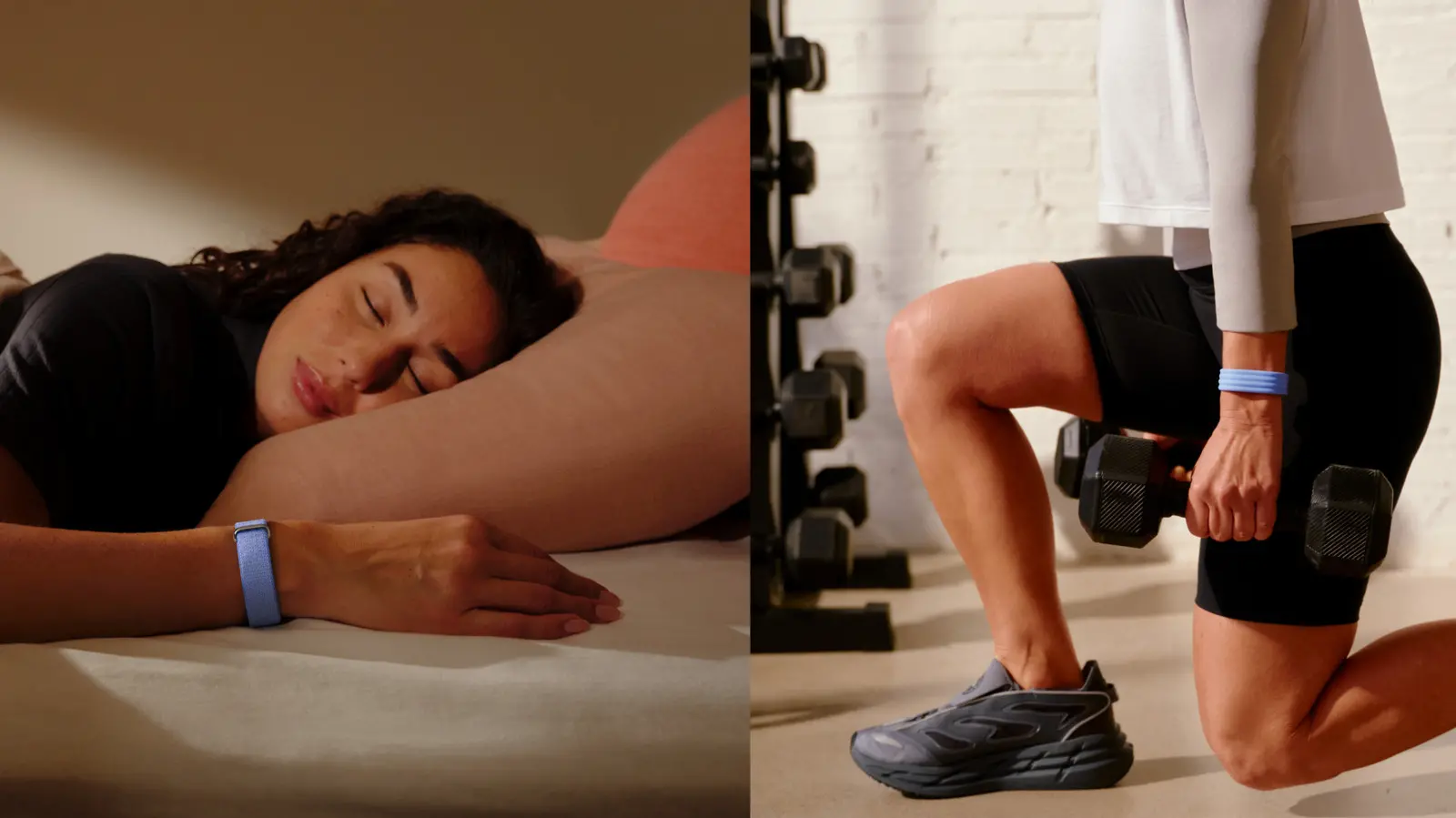
Google has officially launched the Fitbit Air, a screenless wearable that first teased its entry into the minimalist fitness tracker market back in March. The device, which resembles Whoop's core sensor, is designed to be worn in a variety of accessories including a wristband, chest strap, or any other mounting option that users choose. Priced at $100 for pre-order, the Fitbit Air represents a significant departure from traditional smartwatches, focusing purely on passive data collection and AI-driven insights.
The Fitbit Air is notably smaller than its predecessors, measuring 25% smaller than the Fitbit Luxe and 50% smaller than the Inspire 3, according to Google Health general manager Rishi Chandra. Its lightweight construction — just 12 grams with a band and 5.2 grams without — and micro-adjustable fit aim to make the device almost imperceptible during daily activities, exercise, and sleep. Google claims that independent consumer perception studies from last year rated the Fitbit Air as more comfortable than leading competitors in the US wearable market.
As a screenless device, the Fitbit Air relies entirely on its sensors and the companion Google Health app for interaction. It continuously monitors heart rate, using Google’s long-established algorithms to track sleep stages, assign a Sleep Score each night, and provide detailed insights into heart rate variability (HRV). The device also features irregular heart rhythm notifications to detect signs of atrial fibrillation (AFib). These functions echo the core capabilities of competitors like Whoop, but with Google's added layer of artificial intelligence.
The AI-powered features are central to the Fitbit Air experience. The device is powered by advanced machine learning models that Google says are 15% more accurate than previous models. The Sleep Score has also been improved to better reflect recovery. But the crown jewel is the Google Health Coach, a Gemini-based interface introduced in public preview in October. The coach allows users to have a conversational interaction with the Google Health app, receiving personalized suggestions based on their data. It creates dynamic, tailored fitness plans that adapt to real-time performance data and changing schedules, taking into account health data such as Cycle Health and vital medical information. Google emphasizes that user data remains private and secure.
Activity tracking on the Fitbit Air is largely automatic. The wearable can auto-detect common exercises like biking (stationary or outdoor), running, walking, rowing, elliptical, and other high-heart-rate sports. Users can manually start sessions for around 40 types of activities via the app, including aerobics, circuit training, canoeing, dancing, kickboxing, walking, and yoga. Additionally, over 140 activities can be added retrospectively, ranging from archery and assault biking to household chores.
The device provides weekly cardio load and readiness scores, alongside standard metrics like steps, distance, and active minutes. A vibration motor enables silent alarms and Google's Smart Wake feature, which wakes users at the optimal point in their sleep cycle. The Fitbit Air's battery life is estimated at up to a week, with fast charging that provides a day of power in five minutes and a full charge in about 90 minutes. The charger is magnetic and bi-directional, similar to the Pixel Watch 4.
Google is offering three initial band options: a micro-adjustable Performance Loop Band, a sweatproof and wetproof Active silicone band for workouts, and an Elevated Modern Band that turns the device into a fashionable bracelet. The Fitbit Air is water resistant to 50 meters but not officially waterproof. A chest strap or other accessories are not yet available, though Chandra hinted that more bands are in development. A special edition collaboration with basketball star Steph Curry features raised interior print for increased airflow, a water-resistant coating, and signature design details, priced at $130. Every purchase includes three months of Google Health Premium. Orders began on May 7, 2026, and devices will ship on May 26.
The Fitbit Air fits into a broader trend of screenless wearables that prioritize comfort and continuous health tracking over on-device interaction. By integrating AI with Gemini, Google positions the device as a proactive health companion rather than a passive tracker. The Health Coach can interpret data in real time, suggesting adjustments to workouts, recovery periods, and even daily routines. This AI layer differentiates the Fitbit Air from Whoop, which relies on a subscription service and manual journaling. Google's approach offers a more automated, conversational experience that learns from user behavior over time.
Beyond the core health features, the Fitbit Air leverages Google's extensive ecosystem. Users can connect the device to Google Health, which already integrates with other health platforms and services. The AI coach can draw on historical data to provide context, such as how sleep affects cardiovascular health or how stress impacts workout performance. Google has also made strides in improving the accuracy of its sensors, noting that the new machine learning models reduce false positives in heart rate and sleep stage detection. This is crucial for a screenless device where users rely entirely on data presented in the app.
The Fitbit Air also underscores Google's commitment to wearable health after acquiring Fitbit in 2021. The device represents a convergence of Fitbit's hardware expertise and Google's software and AI capabilities. By offering a lower price point and a focus on AI, Google aims to capture both fitness enthusiasts and health-conscious consumers who want a more sophisticated tracker than standard smartwatches. The special edition with Steph Curry adds a sports celebrity endorsement, further boosting the device's profile.
In terms of competition, the Fitbit Air directly targets Whoop's user base, which values minimalism and detailed physiological analytics. However, Google's integration of AI and the Google Health Coach could sway users seeking a more interactive experience without the need for a subscription. The automatic activity detection and seamless app integration provide a comprehensive view of health metrics. While Whoop requires users to manually log activities and subjective ratings, the Fitbit Air's sensors and AI handle much of the data collection and interpretation. This reduces user effort while still delivering personalized insights.
The Fitbit Air also enters a market where smartwatches like the Apple Watch and Samsung Galaxy Watch offer many similar health features, including sleep tracking and heart rate monitoring. However, those devices are larger, have screens, and require more frequent charging. The Fitbit Air's week-long battery and comfort-first design make it more suitable for continuous wear, especially during sleep. For users who do not need a screen, such as those who already carry a smartphone for notifications, the Fitbit Air offers a specialized health tracker that complements their existing devices.
Google's focus on privacy and security is also noteworthy. The company states that health data is private and secure, likely complying with HIPAA and other regulations. The AI coach operates on-device or through secure cloud connections, ensuring sensitive health information remains protected. This is a critical factor for users who may be hesitant to share biometric data with third parties.
Looking ahead, the Fitbit Air could lay the groundwork for future screenless wearables from Google, possibly including adhesive patches or even smart clothing. The modular accessory design suggests that Google sees the core sensor as a platform that can be embedded in various form factors. As AI models become more sophisticated, the Health Coach may incorporate features like stress detection, blood pressure monitoring, or even glucose tracking, pending sensor advancements. For now, the Fitbit Air offers a compelling package for those seeking a discreet, AI-powered health companion.
Source: Engadget News