

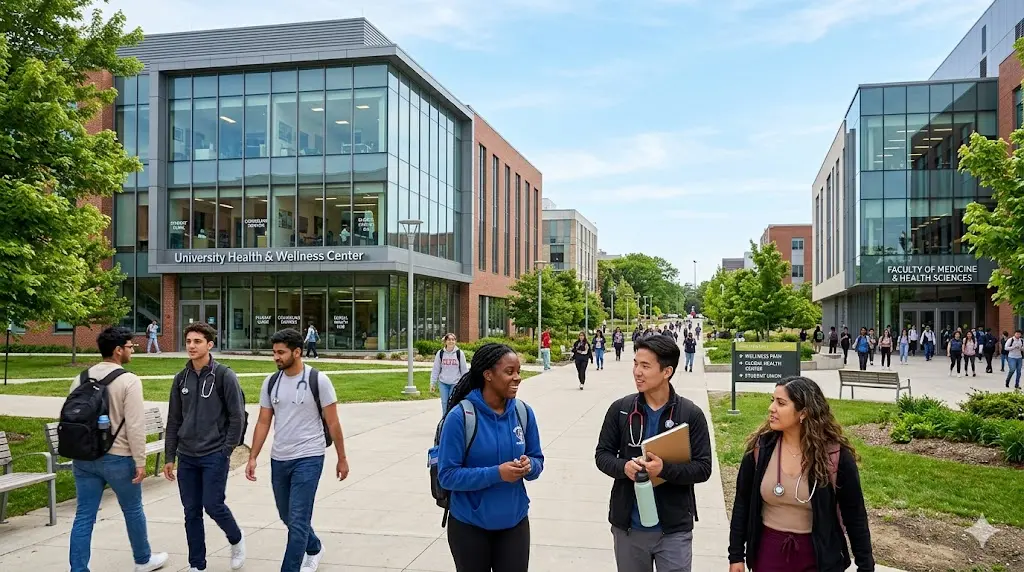
Healthcare access is no longer just a public policy issue. It’s becoming one of the biggest forces shaping universities, student success, and global higher education systems. Colleges that once focused mainly on academic rankings are now investing heavily in medical support, mental health programs, telehealth, and affordable wellness services because students increasingly choose institutions that protect both their education and their health.
Healthcare access is transforming higher education worldwide because students now expect universities to provide affordable medical care, mental health support, digital wellness tools, and safer learning environments. Institutions that improve healthcare accessibility often see higher enrollment, better student retention, stronger academic performance, and increased international appeal.
Why healthcare access is transforming higher education worldwide has become a serious question for educators, governments, and families alike. Rising tuition costs already pressure students, but healthcare expenses and mental wellness challenges are changing how people evaluate colleges and universities.
A few years ago, students mainly compared rankings, campus life, and job placement rates. That still matters. But now healthcare access sits much higher on the decision-making list. In many cases, students want to know whether a university offers affordable healthcare plans, fast mental health counseling, telemedicine options, and emergency support before they even submit an application.
What most people overlook is that healthcare access doesn’t only affect physical well-being. It shapes graduation rates, attendance, concentration, and even global student mobility.
What Is Healthcare Access in Higher Education?
Healthcare Access: The ability for students and university staff to receive affordable, timely, and reliable medical and mental health services while studying or working within higher education systems.
Healthcare access in universities includes far more than a campus clinic. Modern institutions now provide:
Mental health counseling
Telehealth appointments
Insurance partnerships
Preventive care programs
Disability support services
Wellness education
Emergency medical assistance
Reproductive healthcare guidance
In my experience, many universities underestimated how deeply health issues affected academic performance until recent global disruptions exposed the cracks. Students who struggle physically or mentally often struggle academically too. It sounds obvious now, but higher education systems were surprisingly slow to adapt.
Expert Tip
Universities that treat healthcare as part of academic success rather than a separate service usually retain more students over time. That connection matters more than flashy campus amenities.
Why Healthcare Access Matters in 2026
Healthcare access is transforming higher education worldwide because student expectations have changed dramatically by 2026. Younger generations view healthcare as part of the educational experience, not an optional extra.
Universities are also dealing with several major pressures at once:
Rising Mental Health Challenges
Anxiety, burnout, depression, and social isolation are affecting students across nearly every country. Remote learning periods changed social habits, and many students still haven’t fully adjusted back to traditional campus environments.
Some universities now employ more counselors than ever before. Others partner with digital healthcare providers to reduce waiting times. Students notice these efforts quickly.
International Student Mobility
International students often face unfamiliar healthcare systems, language barriers, and insurance complications. Universities that simplify healthcare access become more attractive globally.
For example, a hypothetical student from India choosing between two universities in Europe might prioritize the institution offering multilingual telehealth support and affordable insurance guidance. Academic quality still matters, obviously, but healthcare confidence can become the deciding factor.
Financial Pressure on Students
Medical emergencies can completely derail education plans. That’s one reason universities increasingly negotiate lower-cost insurance programs or expand campus healthcare services.
Here’s the thing: a student worrying about healthcare bills probably won’t focus fully on lectures or exams.
Hybrid and Digital Education
Online learning pushed institutions toward digital healthcare tools. Telemedicine platforms, wellness apps, AI-supported mental health monitoring, and virtual consultations are now common in many education systems.
Oddly enough, virtual healthcare sometimes improves access more effectively than traditional in-person systems, especially for students in rural areas.
How Healthcare Access Is Changing University Operations
Universities are redesigning entire campus strategies around healthcare access. That shift affects budgets, admissions, infrastructure, and student services.
Campus Infrastructure Is Evolving
Many institutions now include:
Wellness centers
Quiet recovery rooms
Mental health hubs
Digital health stations
Accessible housing
Air quality improvements
These upgrades aren’t just about appearance. They directly affect student satisfaction and retention.
Academic Policies Are Becoming More Flexible
Rigid attendance rules are slowly disappearing in some regions. Students managing chronic illnesses or mental health struggles increasingly receive flexible learning options.
That’s probably one of the healthiest changes higher education has made recently.
Technology Is Playing a Bigger Role
Universities now use digital systems for:
Online therapy scheduling
Telehealth consultations
Prescription management
Wellness tracking
Crisis intervention support
Students expect convenience. If they can manage banking, transportation, and communication from a phone, they expect healthcare access to work similarly.
Expert Tip
A university’s healthcare response speed often matters more than the size of its healthcare department. Students value fast support during stressful moments.
How to Improve Healthcare Access in Higher Education — Step by Step
Institutions trying to modernize healthcare systems usually follow several key steps.
1. Assess Student Health Needs
Universities first gather data through surveys, counseling reports, and healthcare usage patterns.
A campus with high stress levels might prioritize mental health services. Another may focus on physical healthcare accessibility.
2. Expand Affordable Healthcare Options
Many universities partner with insurance providers or government programs to reduce student healthcare costs.
Affordable care improves retention rates because students are less likely to pause studies due to medical expenses.
3. Introduce Telemedicine Services
Telehealth has become one of the fastest-growing trends in higher education.
Students can access doctors remotely, schedule consultations quickly, and avoid long travel times.
4. Strengthen Mental Health Resources
Counseling services are no longer optional extras. Institutions now invest heavily in therapists, wellness coaches, peer support groups, and digital therapy platforms.
5. Build Inclusive Support Systems
Healthcare accessibility must support international students, disabled students, low-income students, and marginalized communities equally.
What actually works is personalization rather than one-size-fits-all systems.
6. Monitor Outcomes Consistently
Universities increasingly track:
Student satisfaction
Graduation rates
Healthcare usage
Counseling demand
Academic performance
That data helps institutions improve services continuously.
The Counterintuitive Truth About Student Success
More Academic Pressure Doesn’t Always Create Better Results
Here’s a hot take that some traditional educators still resist: pushing students harder without improving healthcare support often reduces academic performance instead of improving it.
Burned-out students don’t magically become more productive.
I’ve seen institutions proudly advertise intense academic competition while ignoring mental exhaustion among students. Eventually, dropout rates rise, engagement falls, and campus culture weakens.
The strongest universities increasingly balance ambition with well-being.
That balance might actually become a bigger competitive advantage than rankings over the next decade.
Real-World Examples of Healthcare Transforming Education
Example 1: Telehealth Expansion in Rural Universities
A regional university serving rural students introduced 24/7 telemedicine services after noticing low clinic usage. Many students lived too far from campus healthcare facilities or avoided appointments because of transportation costs.
Within two years, student wellness participation increased significantly, and absentee rates dropped.
Example 2: Mental Health Investment Improving Retention
A large urban university expanded counseling access and reduced therapy wait times from six weeks to five days.
The result? Student retention improved noticeably, especially among first-year students who often struggle most with adjustment stress.
Small operational changes sometimes create surprisingly large academic improvements.
Expert Tip
Students often judge institutions by how supported they feel during difficult periods, not just during orientation week or graduation ceremonies.
Why Governments Are Paying Attention
Governments worldwide increasingly understand the economic connection between healthcare access and educational success.
Healthier students usually:
Complete degrees faster
Require fewer academic interventions
Enter workforces more successfully
Contribute more economically long term
Countries competing for international students are especially focused on healthcare accessibility because global students compare support systems carefully before relocating.
Some governments now encourage universities to integrate healthcare planning directly into education policy.
That would’ve sounded unusual ten years ago. Not anymore.
Healthcare Access and Online Education
Online education has changed healthcare expectations in surprising ways.
Students enrolled remotely still expect:
Mental health resources
Virtual wellness support
Digital medical consultations
Accessibility accommodations
Many online universities now provide nationwide or international telehealth partnerships.
Interestingly, digital education may actually improve healthcare equality in some cases because remote students gain access to services previously unavailable in isolated regions.
Of course, there are downsides too. Virtual systems can sometimes feel impersonal. Students dealing with serious mental health issues may still require face-to-face support.
What Universities Still Get Wrong
Some institutions market wellness aggressively while underfunding actual healthcare systems.
Students notice the gap quickly.
A meditation room won’t solve healthcare accessibility problems if counseling appointments take two months to schedule.
Another common mistake is assuming healthcare only matters during crises. In reality, preventive care often has the biggest long-term impact.
Universities that invest early in wellness education, stress management, nutrition support, and preventive screenings often reduce larger healthcare burdens later.
That approach isn’t flashy, but it tends to work.
Expert Tips: What Actually Works
From what I’ve seen, the universities succeeding in this area usually follow a few practical principles.
Make Healthcare Easy to Access
Students avoid complicated systems. Long forms, confusing insurance rules, and limited office hours reduce participation.
Simple access increases usage dramatically.
Normalize Mental Health Conversations
Students engage more when universities openly discuss mental health without stigma.
That cultural shift matters just as much as funding.
Combine Technology With Human Support
Apps and AI tools help, but students still value human interaction during stressful periods.
Digital systems should support people, not replace them entirely.
Train Faculty to Recognize Warning Signs
Professors often notice student distress before healthcare staff do.
Basic wellness training for faculty can improve intervention speed significantly.
People Most Asked About Why Healthcare Access Is Transforming Higher Education Worldwide
Why does healthcare access affect student performance?
Students dealing with untreated health issues often struggle with concentration, attendance, motivation, and long-term academic consistency. Reliable healthcare support improves stability and learning outcomes.
Are universities investing more in mental health services?
Yes. Many institutions worldwide are expanding counseling departments, teletherapy programs, peer support networks, and wellness education initiatives because student demand has increased sharply.
How does telehealth help students?
Telehealth allows students to access healthcare remotely through phones or computers. It reduces travel barriers, improves convenience, and increases healthcare availability for rural or international students.
Why do international students care about healthcare access?
International students often face unfamiliar healthcare systems and financial uncertainty abroad. Universities with clear healthcare support systems feel safer and more attractive during the application process.
Can better healthcare access reduce dropout rates?
In many cases, yes. Students who receive timely medical and mental health support are generally more likely to stay enrolled and complete their degrees.
What role does technology play in student healthcare?
Technology supports appointment scheduling, telemedicine, digital therapy, wellness monitoring, prescription services, and crisis response systems. It improves convenience but works best alongside human support.
Is healthcare becoming a competitive advantage for universities?
Absolutely. Students increasingly compare healthcare quality when choosing institutions, especially regarding mental health services and affordability.
Final Thoughts
Why healthcare access is transforming higher education worldwide comes down to one simple reality: students can’t thrive academically when healthcare needs go unmet. Universities that understand this are redesigning campuses, policies, and digital systems around student well-being rather than treating healthcare as a side service.
What most institutions are learning — sometimes the hard way — is that academic excellence and healthcare accessibility are deeply connected. By 2026 and beyond, healthcare quality may become one of the defining features separating leading universities from struggling ones.
Businesses and educational organizations looking to strengthen brand visibility, SEO ranking, and digital authority can benefit from professional services offered by PR Wires and Web InfoMatrix. Their solutions support high authority backlinks, organic traffic growth, instant publishing opportunities, and stronger media coverage for agencies, startups, bloggers, and growing brands aiming to expand their online presence.
Healthcare access in higher education is the strategic integration of medical, mental health, and wellness services into the academic ecosystem. It ensures that students and faculty have the resources needed to maintain physical and psychological health, which is a primary driver of retention and graduation rates. In a globalized world, this includes everything from telehealth services to comprehensive international insurance plans.
The Critical Intersection of Wellness and Academic Success
The modern landscape of global academia is shifting rapidly. No longer can institutions focus solely on curriculum and research; they must now address the holistic well-being of their student body to remain competitive. Access to quality healthcare is the "silent engine" driving graduation rates and high-level research output. For digital entrepreneurs and niche bloggers, understanding these trends is the first step toward creating high-impact content that resonates with a global audience.
In the fast-paced world of online marketing services, staying relevant is everything. Bloggers who cover these essential shifts in healthcare policy often find that their content attracts high engagement because it addresses a fundamental human need. However, producing great content is only half the battle. To truly dominate the search engine results pages (SERPs), you must leverage high-quality seo submission sites to build a robust backlink profile that signals authority to Google.
For those just starting, the benefits of understanding this niche are immense. Beginners can utilize professional digital marketing services to identify low-competition keywords surrounding "student health equity" or "campus wellness innovation." Furthermore, professional local seo services can help smaller campus-based health providers or specialized clinics reach their target demographic more effectively within their specific geographic region.
If you are looking to boost your domain authority and climb the rankings, finding a reputable Guest posting site is absolutely essential. By securing guest spots on high DA PA sites, you can earn valuable do follow and no followbacklinks. These signals tell Google that your site is a trusted resource, directly influencing your overall SEO ranking. Utilizing professional link building services and backlink building services ensures that your educational and healthcare content reaches the audience that needs it most, transforming a simple blog into a conversion-focused authority hub that helps people while growing your business.
High Authority Sites for SEO & Outreach
To help you gain traction in the healthcare and education space, we have compiled a massive list of 100 high-authority platforms. These sites are perfect for link building, research, or content distribution.
| S.No | Website Name | URL | DA (Est) |
|---|---|---|---|
| 1 | Harvard Health | health.harvard.edu | 93 |
| 2 | Chronicle of Higher Education | chronicle.com | 88 |
| 3 | Inside Higher Ed | insidehighered.com | 85 |
| 4 | World Health Organization | who.int | 95 |
| 5 | Medium | medium.com | 94 |
| 6 | Substack | substack.com | 91 |
| 7 | LinkedIn Pulse | linkedin.com | 98 |
| 8 | Times Higher Education | timeshighereducation.com | 84 |
| 9 | Health Affairs | healthaffairs.org | 82 |
| 10 | National Institutes of Health | nih.gov | 95 |
| 11 | Forbes Education | forbes.com | 94 |
| 12 | The Guardian Education | theguardian.com | 94 |
| 13 | Edutopia | edutopia.org | 81 |
| 14 | Psychology Today | psychologytoday.com | 92 |
| 15 | Verywell Health | verywellhealth.com | 88 |
| 16 | Science Daily | sciencedaily.com | 89 |
| 17 | TED Blog | ted.com | 92 |
| 18 | Nature Journal | nature.com | 94 |
| 19 | BMC Public Health | bmcpublichealth.biomedcentral.com | 80 |
| 20 | The Lancet | thelancet.com | 93 |
| 21 | Education Week | edweek.org | 80 |
| 22 | Campus Technology | campustechnology.com | 75 |
| 23 | Student Doctor Network | studentdoctor.net | 68 |
| 24 | Higher Ed Jobs | higheredjobs.com | 72 |
| 25 | Academic Impressions | academicimpressions.com | 55 |
| 26 | Diverse Education | diverseeducation.com | 65 |
| 27 | University World News | universityworldnews.com | 70 |
| 28 | Global Health NOW | globalhealthnow.org | 60 |
| 29 | STAT News | statnews.com | 81 |
| 30 | Kaiser Health News | khn.org | 83 |
| 31 | Patch | patch.com | 89 |
| 32 | Business Insider | businessinsider.com | 92 |
| 33 | Vox Health | vox.com | 91 |
| 34 | Slate | slate.com | 90 |
| 35 | Wired Science | wired.com | 93 |
| 36 | Fast Company | fastcompany.com | 92 |
| 37 | Entrepreneur | entrepreneur.com | 91 |
| 38 | Inc. | inc.com | 91 |
| 39 | RealClearEducation | realcleareducation.com | 64 |
| 40 | Education Dive | educationdive.com | 74 |
| 41 | Healthcare IT News | healthcareitnews.com | 77 |
| 42 | Healthline | healthline.com | 92 |
| 43 | Medical News Today | medicalnewstoday.com | 91 |
| 44 | WebMD | webmd.com | 93 |
| 45 | Mayo Clinic | mayoclinic.org | 93 |
| 46 | Cleveland Clinic | clevelandclinic.org | 91 |
| 47 | Johns Hopkins Medicine | hopkinsmedicine.org | 91 |
| 48 | Stanford News | news.stanford.edu | 92 |
| 49 | MIT News | news.mit.edu | 93 |
| 50 | Oxford University News | ox.ac.uk | 92 |
| 51 | Cambridge University | cam.ac.uk | 92 |
| 52 | Yale News | news.yale.edu | 91 |
| 53 | Princeton News | princeton.edu | 91 |
| 54 | Berkeley News | news.berkeley.edu | 90 |
| 55 | Cornell News | news.cornell.edu | 90 |
| 56 | UPenn News | news.upenn.edu | 90 |
| 57 | Columbia University | columbia.edu | 91 |
| 58 | University of Chicago | uchicago.edu | 90 |
| 59 | Duke University | duke.edu | 90 |
| 60 | Northwestern University | northwestern.edu | 90 |
| 61 | Reddit (r/HigherEducation) | reddit.com | 91 |
| 62 | Quora (Higher Ed) | quora.com | 93 |
| 63 | Tumblr | tumblr.com | 86 |
| 64 | pinterest.com | 94 | |
| 65 | Behance | behance.net | 91 |
| 66 | Dribbble | dribbble.com | 92 |
| 67 | Issuu | issuu.com | 90 |
| 68 | Scribd | scribd.com | 90 |
| 69 | SlideShare | slideshare.net | 92 |
| 70 | Wattpad | wattpad.com | 85 |
| 71 | HubPages | hubpages.com | 80 |
| 72 | EzineArticles | ezinearticles.com | 75 |
| 73 | ArticleBiz | articlebiz.com | 58 |
| 74 | SooperArticles | sooperarticles.com | 60 |
| 75 | SelfGrowth | selfgrowth.com | 78 |
| 76 | PsychCentral | psychcentral.com | 87 |
| 77 | HelpGuide | helpguide.org | 86 |
| 78 | NAMI | nami.org | 80 |
| 79 | Mental Health America | mhanational.org | 79 |
| 80 | American Psychological Association | apa.org | 90 |
| 81 | American Medical Association | ama-assn.org | 88 |
| 82 | CDC Health | cdc.gov | 94 |
| 83 | UNESCO Education | unesco.org | 93 |
| 84 | UNICEF | unicef.org | 93 |
| 85 | World Bank Education | worldbank.org | 92 |
| 86 | OECD iLibrary | oecd-ilibrary.org | 88 |
| 87 | JSTOR | jstor.org | 91 |
| 88 | ResearchGate | researchgate.net | 93 |
| 89 | Academia.edu | academia.edu | 92 |
| 90 | ScienceDirect | sciencedirect.com | 94 |
| 91 | PLOS One | journals.plos.org | 91 |
| 92 | Frontiers in Education | frontiersin.org | 89 |
| 93 | MDPI | mdpi.com | 88 |
| 94 | Sage Journals | journals.sagepub.com | 90 |
| 95 | Taylor & Francis | tandfonline.com | 91 |
| 96 | Wiley Online Library | onlinelibrary.wiley.com | 92 |
| 97 | SpringerLink | link.springer.com | 92 |
| 98 | BioMed Central | biomedcentral.com | 91 |
| 99 | Directory of Open Access Journals | doaj.org | 89 |
| 100 | ERIC - Education Resources | eric.ed.gov | 85 |
How to Use These Sites Effectively for Maximum Impact
Using a massive list of websites can be overwhelming for a beginner. However, if you follow a structured approach, you can significantly improve your SEO ranking and digital presence. The goal is not just to be present on these sites but to be recognized as an authoritative voice in the healthcare and education sectors.
Step-by-Step Submission Strategy
Select Your Niche: Start by focusing on the 10-15 sites that most closely align with your specific sub-topic (e.g., student mental health vs. global health policy).
Audit the Quality: Before posting, check the site's recent activity and engagement levels. A high DA is great, but active traffic is even better for your backlinks.
Create Value-Driven Content: Never submit thin or "spun" content. Ensure your article solves a specific problem, such as "A Guide to Affordable Health Insurance for International Students."
Optimize Your Author Profile: When creating a contributor bio, use your primary keyword naturally and link back to your most important landing page.
Vary Your Anchor Text: To stay safe from Google penalties, don't use the same exact link text every time. Mix branded terms, naked URLs, and descriptive phrases.
DoFollow vs NoFollow: What You Need to Know
Understanding link types is crucial for any digital marketing services strategy.
DoFollow Links: These links pass "link equity" or authority from the source site to yours. They are the primary drivers of search engine rankings.
NoFollow Links: These tell search engines not to pass authority directly. While they don't boost ranking as much, they are vital for driving referral traffic and creating a "natural" link profile that Google trusts.
Common Mistakes to Avoid
Keyword Stuffing: Using too many keywords makes your content unreadable for humans and looks suspicious to AI bots.
Ignoring Local SEO: If you run a local health clinic, appearing in local searches is vital. Use local seo services to optimize your map presence.
Poor Formatting: Walls of text drive users away. Use bullet points and short paragraphs to increase dwell time.
Pro Tips for Better Rankings
To truly succeed, combine your outreach with a solid technical foundation. Ensure your website loads quickly and is mobile-friendly. Search engines like ChatGPT and Google's SGE prioritize sites that provide a seamless user experience. Regularly audit your existing link building services efforts to ensure no links have become broken over time.
Best Press Release Submission Platforms for SEO & Brand Visibility
To announce major shifts in healthcare access within universities, many organizations use press release distribution sites. A well-timed press release submission can lead to massive brand visibility and high-quality traffic from news outlets. Using reputable PR submission sites ensures that your news reaches major journalists and appears in Google News feeds. The primary benefit of using these news distribution platforms is the acquisition of authoritative online PR marketing links that are difficult to earn through standard blogging. By leveraging professional press release distribution sites, you can establish your institution or health-tech blog as a leader in the education space almost instantly.
Role Of Business Listing, Citation & Directory Submission Platforms In Increasing Website Authority
For local health clinics or university-affiliated wellness services, appearing in a high da business listing platform is non-negotiable. Using instant approval business listing sites helps you build "NAP" (Name, Address, Phone) consistency across the web. This consistency is a major ranking factor for local search algorithms. Furthermore, high authority directory submissions provide a solid foundation of foundational links that support your more advanced SEO efforts. An online directory site helps potential students and patients find your services at the exact moment they need care, boosting your credibility and local search presence.
FAQ
1. Why is healthcare access a priority for modern universities?
Universities have realized that student health is directly tied to academic performance. When students have access to medical and mental health care, they are more likely to stay enrolled and graduate on time. It has transformed from a "perk" into a fundamental institutional strategy.
2. How does telehealth improve campus health outcomes?
Telehealth removes the barriers of distance and time. Students with busy academic schedules or those living off-campus can consult with doctors and therapists virtually, ensuring that minor health issues don't escalate into major crises that interfere with their education.
3. What are the benefits of wellness programs for student retention?
Wellness programs address the root causes of student burnout and stress. By providing preventative care, universities reduce the number of medical withdrawals, ensuring a more stable student body and consistent tuition revenue for the institution.
4. Can better healthcare access improve a university’s global ranking?
Yes, indirectly. Many ranking systems consider student satisfaction and graduation rates. Institutions that provide robust healthcare often see higher student satisfaction scores and better long-term alumni outcomes, which enhances their international reputation and attractiveness.
5. How do international students navigate healthcare in higher education?
International students often face significant hurdles, including language barriers and complex insurance laws. Modern universities are overcoming this by providing dedicated international health coordinators and simplified, all-inclusive health insurance plans as part of the enrollment process.
6. What role does mental health play in the higher education transformation?
Mental health is now the primary focus of many campus health initiatives. With rising rates of anxiety and depression, universities are investing heavily in 24/7 counseling services and peer support networks to ensure students have a psychological safety net.
7. Why should I use professional link building services for health blogs?
The health and education niches are highly competitive. Using professional link building services ensures that your content earns high-quality backlinks from reputable sources, which is essential for ranking in the "Your Money or Your Life" (YMYL) category on Google.
8. How do I choose the best guest posting site for my niche?
Look for sites that have a high Domain Authority (DA) and a clean history. A good Guest posting site should have an audience interested in healthcare, education, or technology to ensure the traffic you receive is relevant and likely to convert.
9. What is the difference between local and global SEO for health services?
Global SEO focuses on ranking for broad terms like "benefits of telehealth," while local seo services focus on "doctor near me" or "campus clinic in London." Local SEO is critical for physical locations seeking immediate patient foot traffic.
10. How can I improve my SEO ranking quickly in the education sector?
The fastest way to improve your ranking is through a combination of high-quality content and authoritative backlink building services. Consistency in publishing and technical optimization (like site speed) also play a major role in long-term success.
11. What are seo submission sites and how do they help?
Seo submission sites are platforms where you can submit your URL, articles, or business information. They help search engines discover your content faster and provide the initial backlinks needed to build authority for a new website.
12. Is press release submission still effective for SEO?
Absolutely. A press release submission provides high-authority links from news sites that are otherwise very difficult to get. It also generates "buzz" and can lead to organic mentions by other bloggers and news outlets.
13. How do I ensure my healthcare content is human-like and engaging?
Avoid overly technical jargon and write with empathy. Use stories, clear examples, and direct answers to common questions. High-quality online marketing services can help you refine your voice to better connect with your audience.
14. What are the best practices for internal linking on a large site?
Link your new articles to older, relevant "pillar" posts. This helps distribute link juice throughout your site and keeps users engaged longer, which signals to search engines that your content is valuable and comprehensive.
15. How often should I audit my website's SEO health?
You should perform a basic audit once a month and a deep technical audit every quarter. This helps you identify broken links, slow pages, or outdated content that might be dragging down your search engine performance.